La Strada, Le Route, The Road – Richard Demarco
La Strada, Le Route, The Road
an exhibition about the life of Richard Demarco.
Initiated and produced by Deirdre MacKenna for Museo Nazionale del Molise, Castello Pandone, Venafro, Italy.
12 October 2019 – 12 January 2020
This exhibition ‘La Strada, Le Route, The Road’ was one element of a wider research-led programme I devised to enable an international diasporic community to reflect on the transition of its identity.
Richard Demarco would be the first member of the international diaspora to be presented in the ‘home’ location, offering an opportunity to reflect on experiences which punctuate gradual change over multiple generations of time, and the identity of the diasporic community ‘abroad’.
Richard Demarco has been an influential figure in my life for over thirty years: like him, my heritage is populated by ancestors who originated in the mountain villages surrounding Venafro, and I share his practice of researching, commissioning, producing and presenting narratives through visual art in an ongoing process of piecing together fractured stories.
I chose to present Richard’s work in Venafro as it is an anchor town in the international diasporic community we are members of; set on the eastern limit of the flat Casalina plain which links Naples with Rome, it is a strategic cultural and commercial junction before the ascent into the Mainarde mountains which block east from west central Italy. Human travel is etched into the topography surrounding Venafro, in the pilgrimage routes exiting Europe towards the Holy Land, in the ‘tratturi’ (mile-wide roadways visible only in satellite images which evidence thousands of years of seasonal nomadism) and in the empty rural villages, for centuries over-populated but now quietly crumbling into the forest. The current flow of migration from Venafro’s communities started in the 1830s, and this apparently sleepy rural community has become the central cog in its diasporic community located in capital cities throughout Europe, Russia, Australia, the USA, Canada and Brazil.
The complex sense of identity at the heart of the Venafro diaspora is compounded in many ways, not least by the failure of successive public administrations to acknowledge its citizens-abroad and provide means for collective self-reflection; with the opening of Museo Nazionale del Molise, Castello Pandone in December 2014 the possibility arrived for members of the diasporic community to engage in an open process of finding itself. ‘La Strada, Le Route, The Road’ was part of the programme I had devised and already presented in some of these cities, and was the third exhibition I devised for Castello Pandone; predecing exhibitions introduced some of the causal factors of outward migration of agrarian workers such as steady employment opportunities provided by the development of railways from Naples in the 1840s and the occupation of the territory as a site of sustained WWII conflict during the 1940s.
I researched the exhibition content during a series of meetings with Richard and Charles Stephens in 2017 and 2018 and identified the images in three ways: from the archives at Summerhall, by asking Richard to search further through his own personal archives and by approaching some of his family members. Previously unpublished images include, amongst others, a self-portrait made by Richard aged eighteen, his drawings of his father Carmino; drawings of the Mancini family models who are part of the same diaspora which Richard made while a student at ECA, and images from his lesson-plan sketches as a young teacher, which illustrate him thinking through the roadway as a metaphor.
The images were arranged in vitrines in chronological order, from ancestry to today; I worked with the museum staff to ensure that attenders entered the three galleries at the beginning of the exhibition-route and completed their journey in the Gran Sala, with views over Venafro and the Casalina plain below, offering escape from the rural, agrarian way of life along routes towards cities beyond the horizon. Rather than describe my view of how the exhibition was relevant to the community members of the Venafro area, posters announcing Richard’s surname (indigenous to the community) activated an open enquiry process “qui è / who is he?”, and a booklet in English and Italian languages provided information about each of the images.
The first vitrine contained Richard’s family tree alongside photographs of ancestral events set in an increasingly diverse range of international locations, portraying each successive generation’s location in an ever more distant city, with the spectre of war constantly present in the background of Richard’s own formative years. I knew that Richard’s images would resonate strongly with images in the viewer’s personal family archives and that in recognising chapters of Demarco’s life, I anticipated that they would self-identify with Richard and start to process their encounter through the exhibition simultaneously through their own ancestry and sense of their own international diasporic self.
The second vitrine contained images of Richard’s youth including his self-portrait, his drawings of his father, and the Mancini family models, linking Richard back into the nineteenth century European Belle Epoque; when they arrived in new cities, the creative and entrepreneurial ancestors of this diasopra contributed to dynamic cultural advances in many ways such as by importing and marketing goods as exotic new products and working as models to avant-garde artists including Matisse and Modigliani, evident today in museums throughout Europe, in the sculptures of Hyde Park and Place de la Concorde, and in ‘La Semeuse’, the iconic image on the French franc.
The images in the second room continued Demarco’s early artistic works; sketches of roadways from his lesson-plans during his time as a teacher and a selection of his paintings from ‘The Road to Miekle Seggie’; despite the road being a core element in the collective consciousness of this community, it is extremely rarely addressed. The 1967 image of Demarco and Emilio Coia depicts two sharp-dressed young creatives at the entrance to the Demarco Gallery in Melville Crescent, Edinburgh; their glances, aware of both the camera and each other, evidence their shared heritage and ambitious burgeoning identities.
The vitrines and banners of the final room displayed both Richard’s achievements as an established practitioner and also accolades stimulated by his work, concluding with his most recent activities at the heart of the contemporary art world at the Venice Biennale and his return to contextualise his life and work through the imaginary portal which coastal west Scotland has represented to him since his evacuation as a ten year old during WWII.
The prescribed route through the exhibition came to an end at a junction between rooms and offered an opportunity to look back towards the beginning of the exhibition, and re-consider its stories, in reverse-order, from the present into the past. This offered visitors, Richard and me an opportunity to reflect again on Richard’s ancestry and life in relation to ours. There was a sense of journey and expanded territory, unrestricted by state borders and cultural conventions, and of both consistency and evolution that indicated towards new or third cultures.
‘La Strada, Le Route, The Road’ enabled me to bring specific aspects to the forefront of Richard’s attention; how his ancestry of travel had defined his sense of territorial identity; the role his father played in developing Richard’s awareness of his entitlement to multiple places and cultures; the extent to which Richard has been affected by the impact of war on the lives of ordinary people; the role models Richard encountered during his youth, and how these aspects have shaped Richard’s sense of the possibilities in his work. In turn the sense of enduring professional and personal quest which Richard represents to me endorses my own ongoing work piecing together traces of cultural identities to make my sense of the past and present.
For the publicity for ‘La Strada, Le Route, The Road’, I chose an image by Doug Corrance (date unknown) of Demarco in his prime, dynamic and focused, with the off-kilter colours of the Italian national flag of Italy behind him.
Connected Images

Richard Demarco at Museo Nazionale Castello Pandone 2019 © Cultural Documents

self portrait by Richard Demarco 1948 © Richard Demarco

Emilio Coia and Richard Demarco outside The Demarco Gallery in Melville Street Edinburgh 1967 © The Demarco European Art Foundation

Inaugurazione Richard Demarco at Museo Nazionale Castello Pandone 2019 © Cultural Documents

Inaugurazione Richard Demarco at Museo Nazionale Castello Pandone 2019 © Cultural Documents

Inaugurazione Richard Demarco at Museo Nazionale Castello Pandone 2019 © Cultural Documents
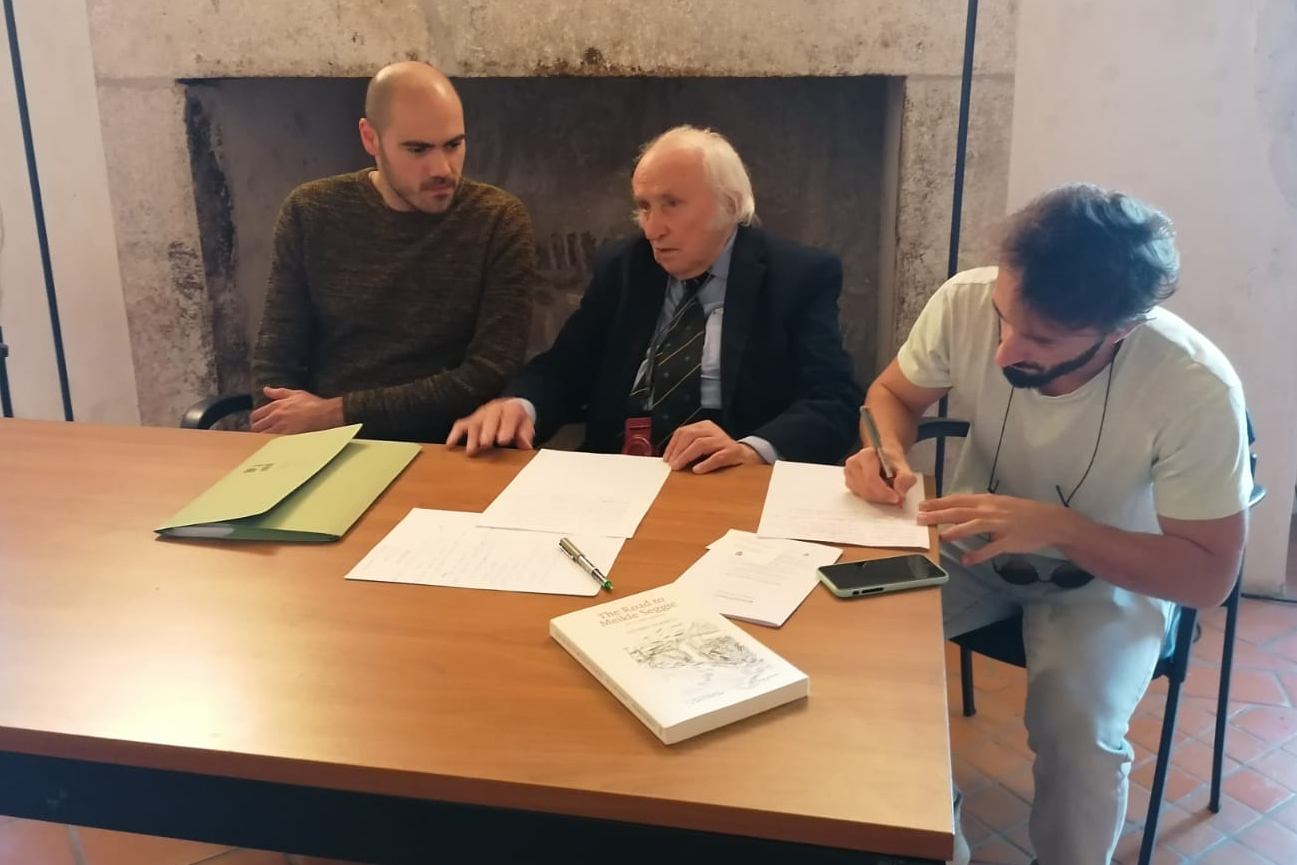
Riccardo Gentile Lorusso, Richard Demarco and Luca Ferri - Inaugurazione Richard Demarco at Museo Nazionale Castello Pandone 2019 © Cultural Documents

Vitrine 2 - Richard Demarco, la strada, le route, the road. Museo Nazionale Castello Pandone 2019 © Cultural Documents

Richard Demarco Event 12 October 2019 Museo Nazionale Castello Pandone 2019 © Cultural Documents

Richard Demarco Event 12 October 2019 Museo Nazionale Castello Pandone 2019 © Cultural Documents

Richard Demarco Event 12 October 2019 Museo Nazionale Castello Pandone 2019 © Cultural Documents

Richard Demarco Event 12 October 2019 Museo Nazionale Castello Pandone 2019 © Cultural Documents

Richard Demarco Event 12 October 2019 Museo Nazionale Castello Pandone 2019 © Cultural Documents

Richard Demarco Event 12 October 2019 Museo Nazionale Castello Pandone 2019 © Cultural Documents

Richard Demarco Event 12 October 2019 Museo Nazionale Castello Pandone 2019 © Cultural Documents
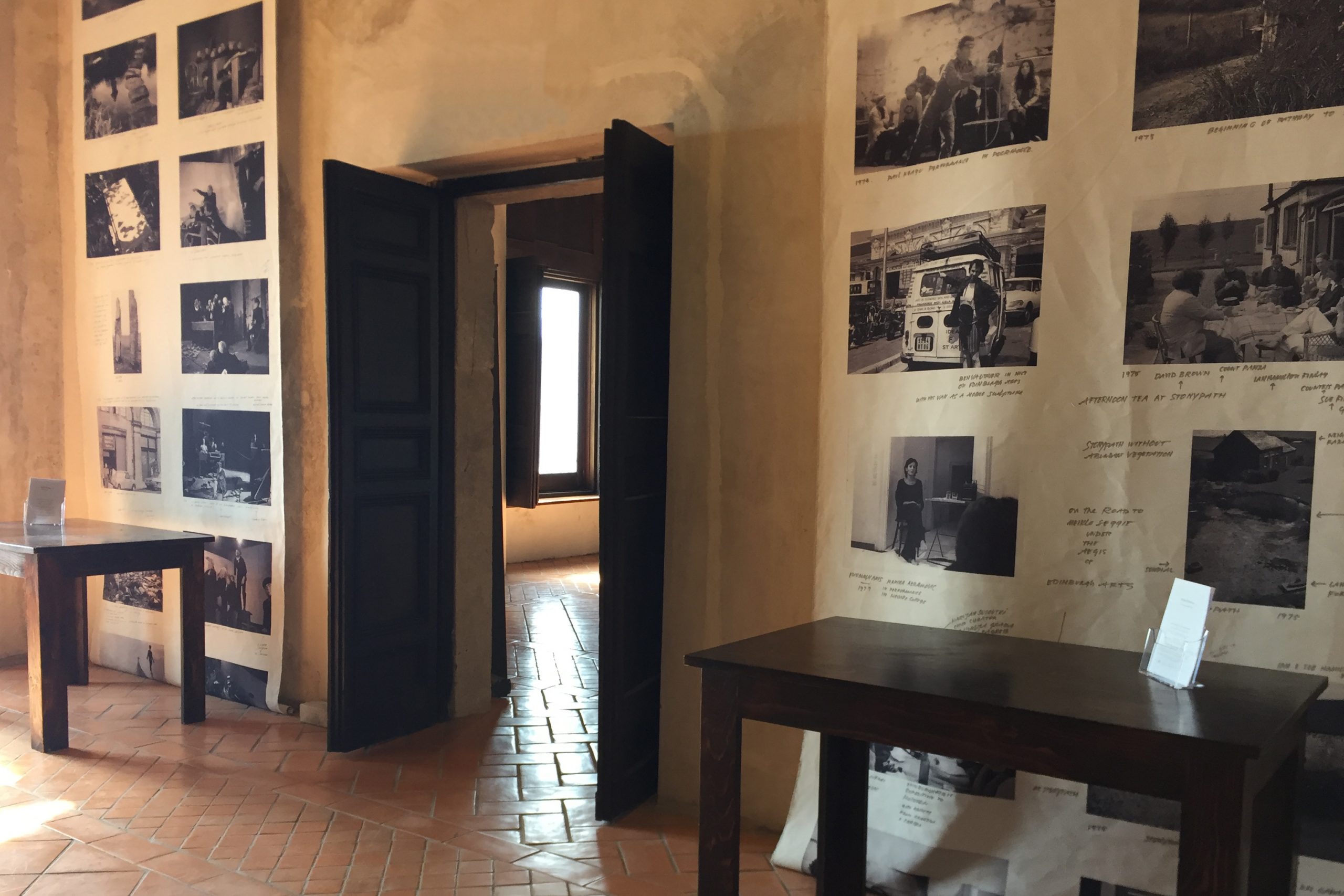
vitrine 1 Richard Demarco, la strada, le route, the road. Museo Nazionale Castello Pandone 2019 © Cultural Documents

Richard Demarco at Museo Nazionale Castello Pandone 11 October 2019 © Cultural Documents

Richard Demarco and Terry Ann Newman at Museo Nazionale Castello Pandone 11 October 2019 © Cultural Documents

Richard Demarco at Museo Nazionale Castello Pandone 11 October 2019 © Cultural Documents

Richard Demarco in Filignano 13 October 2019 © Cultural Documents

Richard Demarco at Cultural Documents Artists' house, Filignano October 2019 © Cultural Documents

Richard Demarco looking across the raised landmass between the Volturno and Rapido rivers 13 October 2019 © Cultural Documents


