Caiazzo. Monte Carmignano. Prov Caserta. 13.10.1943
Notes to accompany research for the ‘Caiazzo’ project:
Known as the Cáin Adomnáin, the earliest recorded law to protect innocent civilians during wartime conflict was approved by Irish and Scots legislators in 697.
The sentence of 25 October 1994 remains the only sentence of a Nazi criminal in Italy pronounced by a Court of Assize with civilian jurors.
The Atlante Stragi Nazifasciste (database of nazi massacres in Italy) aims at listing every one of over 5,000 episodes of intentional killing of defenceless innocents perpetrated between 1943 and 1945 by Nazi and fascists: http://www.straginazifasciste.it/?page_id=316&lang=en
The Atlante Stragi Nazifasciste page on Caiazzo Monte Carmignano is at this page: http://www.straginazifasciste.it/?page_id=38&id_strage=371&lang=en
Nome dei vittimi
(Masseria Monte Carmignano, 13 ottobre)
Albanese Antonio, contadino, anni 14
D’Agostino Francesco, contadino, anni 39
D’Agostino Orsola, contadina, anni 73
Insero Angela, contadina, anni 34
Massadoro Raffaele, contadino, anni 26
Massadoro Vito, contadino, anni 28
Perrone Nicola, contadino, anni 37
(Masseria Albanese, 13 ottobre)
Albanese M. Angela, contadina, anni 20
Albanese Maria, contadina, anni 18
Albanese Elena, contadina, anni 16
Albanese Angelina, scolara, anni 12
D’Agostino Saverio, contadino, anni 12
D’Agostino Antonio, contadino, anni 10
D’Agostino Orsola, scolara, anni 8
D’Agostino Carmela, scolara, anni 6
Di Sorbo Anna, contadina, anni 34
Palumbo Raffaele, contadino, anni 47
Perrone Giuseppe, contadino, anni 12
Perrone Antonetta, scolara, anni 9
Perrone Margherita, scolara, anni 6
Perrone Elena, anni 3
Santabarbara Orsola, contadina, anni 63
Characters:
William Stoneman.
Born 15.05.1904 Grand Rapids, Michigan USA. Died Paris aged 83 (April 1987) -where he had lived since his retirement in 1969.
He was the first journalist to arrive at Monte Carmignano and see the cadavers.
http://articles.chicagotribune.com/1987-04-15/news/8701280746_1_v-e-day-invasion-wounded
He wrote the article for the Chicago Daily News which was published in October 1943.
William H. Stoneman, 83, a Chicago Daily News foreign correspondent and analyst, was in the thick of World War II and the events that led up to it. He was blacklisted in Nazi Germany, wounded in North Africa, had his home bombed in London, went ashore at Normandy and was the paper`s London correspondent for 11 years after V-E Day and retired in 1969 to Paris.
He became Assistant to Trygve Lie, the first elected Secretary-General of the United Nations.
Stoneman was with Raffaele e Domenico and found the epaulettes of the 29 Panzer Division which he informed Habe.
1943: Ha promesso due cosi
- di sepilire responsabile a i piedi dei vittime (metaforico)
- di aiutare
e’ andato a Benedetto Croce per scrive un momumanto ai le vittime/caduti
Habe then interrogated the soldiers and they arrested them near Venafro at Piedemonte Matese Letino Pratella.
1946 : he wrote to US Colonel Marcus ‘I saw the women and children killed in Caiazzo – where has the case gone?’
19?? Stoneman then wrote to the ministro Italiano who said to leave it all alone and there the story ends with Italy.
1949 He also wrote to the Bishop of Caiazzo in 1949 but the letter was ‘found’ in a book in 1988 and the assumption is that it was put aside in order to let any investigation go cold.
He was aware that Hans Have had secured the commitment of Simon Wiesenthal to pursue the case.
Stoneman – a man with white hair and a stick whowalks along the banks of the river Siene in Paris. Someoe says “perche non torni negli Stati Uniti?” and he replies “Le autorita militari, gli Alliati, e in Italia nessun ha alzato un ditto per asicurare la giustizia”.
Hans Habe (12 February 1911, Budapest – 29 September 1977, Locarno)
Habe was a prolific, influential and fascinating character, making significant contributions in Europe and the USA throughout his life:
1943 – carried out the first interrogations of Lehnigk-Emden and fellow soldiers at Aversa near Caserta/Naples. (they were arrested near Venafro at Piedemonte Matese Letino Patella.)
1969 Habe wrote to Simon Wiesenthal the famous Nazi hunter; ‘c’e’ un criminale nazi in liberta and sent the documentation. Wiesenthal started to look, but he was looking for the wrong surname. In fact Emden was easily finable because…
Habe wrote about Caiazo in ‘All My Sins’ page 340 and 341
He spelled Lemick as Lehnigk-Embden
Herbert Matthews – Herbert Lionel Matthews (1900 – 1977 USA)
journalist NYT Times – he wrote the article that Agnone found in the library (he was the first famous for interviewing Castro).
? was also present and saw the bodies at Caiazzo on 14.10.1943 ?
Hubert Renfro Knickerbocker (January 31, 1898 – July 12, 1949) was an American journalist and author. He was nicknamed “Red” Knickerbocker from the color of his hair.
Was with Stonemason, Matthews, Have et al in Italy in the salts preceding Caiazzo.
(Giuseppe) Joseph Agnone (???April 24, 1930 ~ Thursday, Feb. 16, 2017 (age 87))
Joseph Agnone, 87, of South Plainfield, N.J., died on Thursday, Feb. 16, 2017 – http://www.therossifuneralhome.com/obituary/4114800
Born Castel Cisterna di Sasso near Caiazzo.
He had a passion for researching and studying WWII, the battle of the Volturno etc.
He wrote ‘La Barbaria E Il Coraggio’ about Caiazzo.
In 1984 read an article in the New York Times and subsequently went to Maryland to read the file which he then sent to Albano.
His meeting with Lenzt was fiction.
http://www.therossifuneralhome.com/obituary/4114800: Joseph Agnone, 87, of South Plainfield, died on Thursday, February 16, 2017. Friends and family will gather for a visitation on Monday, February 20, 2017 from 5-8pm at the Rossi Funeral Home, 1937 Westfield Ave., Scotch Plains, NJ 07076. Funeral Service and Entombment will be Private on Tuesday.
Joseph was born in Castel Di Sasso, Province of Caserta, Italy. He immigrated to the United States in 1956 to Westfield, NJ. Joseph moved back to Italy and to Westfield, before settling to South Plainfield in 1981. Joseph worked as an Interpreter while living in Italy for Giovanni APA Co., which was a factory that produced Cameos. Then, Joseph worked at Lucent Technologies in Security for 15yrs., retiring in 1993. He belonged to the Deutscher Club in Clark and the French Club at Lucent Technologies. Joseph was self taught in speaking 5 languages, and loved to read and educating himself. He was considered a historian of World War II. Joseph authored the book, “La Barbaria E Il Coraggio”, which was about war crimes during World War II. He enjoyed classical music, collecting stamps and coin, and his real passion was spending time with his grandchildren. He was also an avid gardener.
Joseph is survived by his wife of 59yrs. Elvira (nee Negri); his three daughters Frances Agnone, Mariangela DelSordi (John), and Luisa Bianco (Luigi); his two brother John and Pasquale; and his grandchildren Michael DelSordi, Vincenzo Bianco, John DelSordi, Joseph Bianco, Maria DelSordi, and Elisa Bianco.
Colonel Young – he is real:
In 1949, he is in the post that Col Marcus was in 1946 and so Stoneman writes to him asking why he never got an answer.
It is then that Col Young explains to Stoneman that the Allies (English) released Emden return to Germany after the war as a free man.
Colonel Marcus. When he responded to Stoneman he pretended that he didn’t know that Emden had returned to Germany a free man. And the folder was sent to the Italian Government saying it was their responsibility.
Lantz / Lanzt (Capitano 3rd Infantry Division) – he did not meet Agnone but he would have had a 3rd Infantry Division book. Antimo thinks he became a professional football player after the war.
Under the command of General Truscott, Lucian King Truscott, Jr. (1895 – 1965)
Paolo Albano
co-author of La Strage di Caiazzo with Antimo Della Valle
https://www.ibs.it/libri/autori/Paolo%20Albano
Senior prosecutor for the Provincia Isernia (Molise)
http://www.kairosnet.it/nws/blog/2017/11/24/intervista-al-dott-paolo-albano-procuratore-della-repubblica-presso-il-tribunale-di-isernia/
Antimo Della Valle
researcher and author of a Strage di Caiazzo with Paolo Albano
Peter Schmickler the Koblenz prosecutor
Dates…
Raffaele e Domenico
family members of the victims
Dates…
Lehnigk-Emden (Lehnigk Emden Wolfang nato il 10.12.1922 a Calau – 2006)
http://www.difesa.it/Giustizia_Militare/rassegna/Processi/LehnigkEmdenSchuster/Pagine/default.aspx
http://www.newyorker.com/magazine/1946/01/12/lieutenant-lemick-emden
http://archives.newyorker.com/?i=1946-01-12#folio=052
Co-accused with
Schuster Hans nato il 4.12.1919 a Crailsheim
Gnass Hans nato il 21.4.1914 a Berlino
Zabel Johenh nato il 29.11.1922 a Fuerstenwalde.
John Lardner –
Was present and wrote article in New Yorker 05 or 12 January 1946.
REPORTER AT LARGE about Lt. Lemick-Emden and about atrocities committed in the village of Caizzo, in the Volturne sector, where several farmers & their families were killed. The Leiutenant’s crime was known before his capture, & after hours of questioning he finally signed a full confession, but held that the farmers were killed because of blinking signals to American planes or ground troops by opening and closing their window shutters at night. No American planes were known to have operated in that sector, & the ground forces were 48 hours away. Lemick-Emden was not convicted as a war criminal because the Army feared that publicity which even suggested that he was liable to punishment would make trouble for American prisoners in the enemy hands. When last heard of Lemick-Emden had been recaptures after escaping from a prison in Algeria.
http://archives.newyorker.com/?i=1946-01-12#folio=052
He spelled Lemick-Emden
Benedetto Croce (born February 25, 1866, Pescasseroli (Abruzzo), Italy—died November 20, 1952, Naples)
was asked by William Stoneman to write the epitaph for the memorial:
Presso Caiazzo/nel luogo detto San Giovanni e Paolo/alcune famiglie campagnuole /rifugiate in una stessa casa/furono il 13 ottobre MCMXLIII / fucilate e mitragliate /per ordine /di un giovane ufficiale prussiano/ uomini, donne, infanti/ ventidue umili creature/non d’altro colpevoli / di aver inconscie/ alla domanda dove si trovasse il nemico/additato a lui senz’altro la via/ verso la quale s’erano volti i tedeschi/ improvvisario/nelle umane guerre/ma l’atroce presente nemico/dell’umanità.
Cecil Sprigge
present at opening of film, and en route to Salerno.
Italian cores for Manchester Guardian and author of Croce, Modern Italy etc
https://www.goodreads.com/author/show/7246283.Cecil_J_S_Sprigge
his papers are at – https://www.reading.ac.uk/special-collections/collections/sc-sprigge.aspx / https://www.reading.ac.uk/web/files/special-collections/SpriggeHandlist.pdf
Australia, Belgium, Brazil, Bulgaria (from 1944), Canada, Colombia, Cuba, Czechoslovakia, Ethiopia, Finland (from 1944), France, Greece, Italy (from 1943), Luxembourg, Mexico, Netherlands, New Zealand, Norway, Philippines, Poland, Romania (from 1944), South Africa, and Yugoslavia. 23.
Connected Images
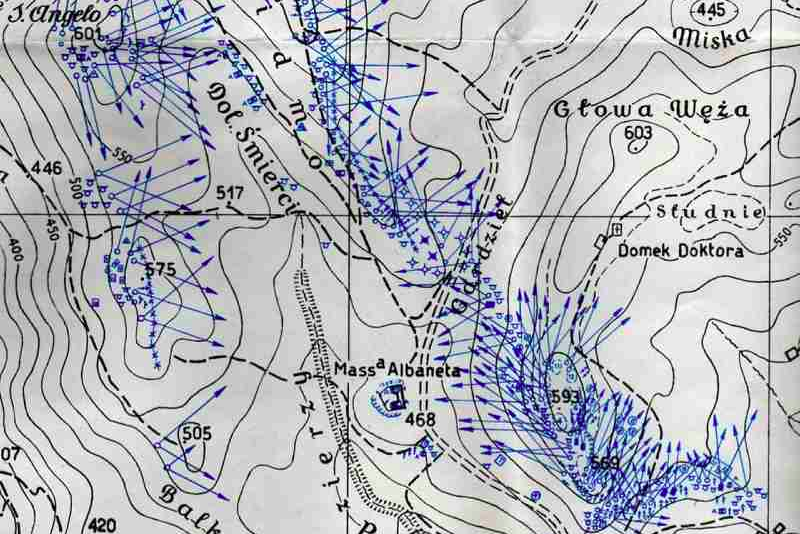
© Dal Volturno a Cassino Kompanii Geograficznej Korposu
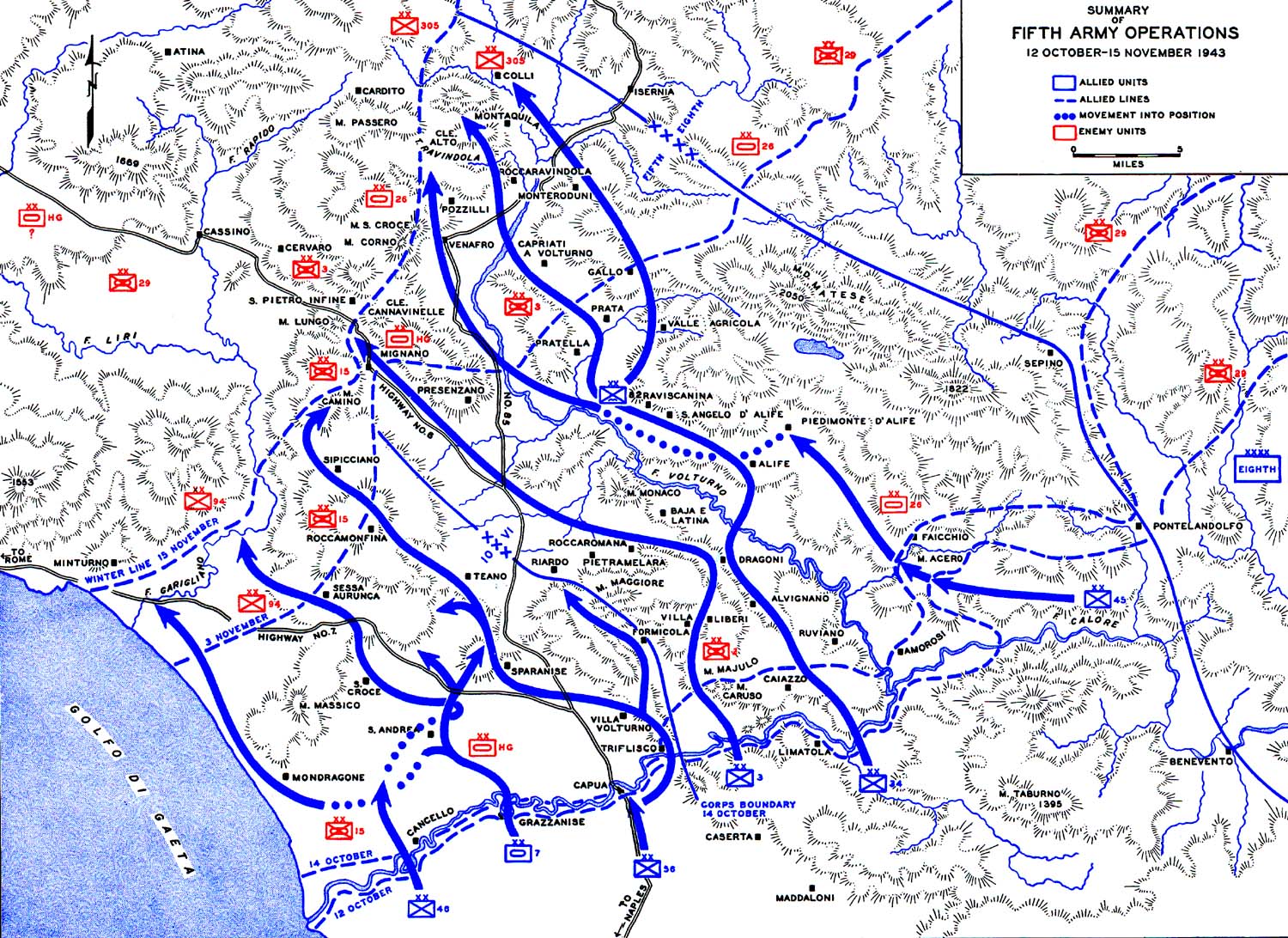
Volturno area; Fifth Army Operations 12 October to 15 November 1943. © This work is in the public domain under the terms of Title 17, Chapter 1, Section 105 of the US Code.
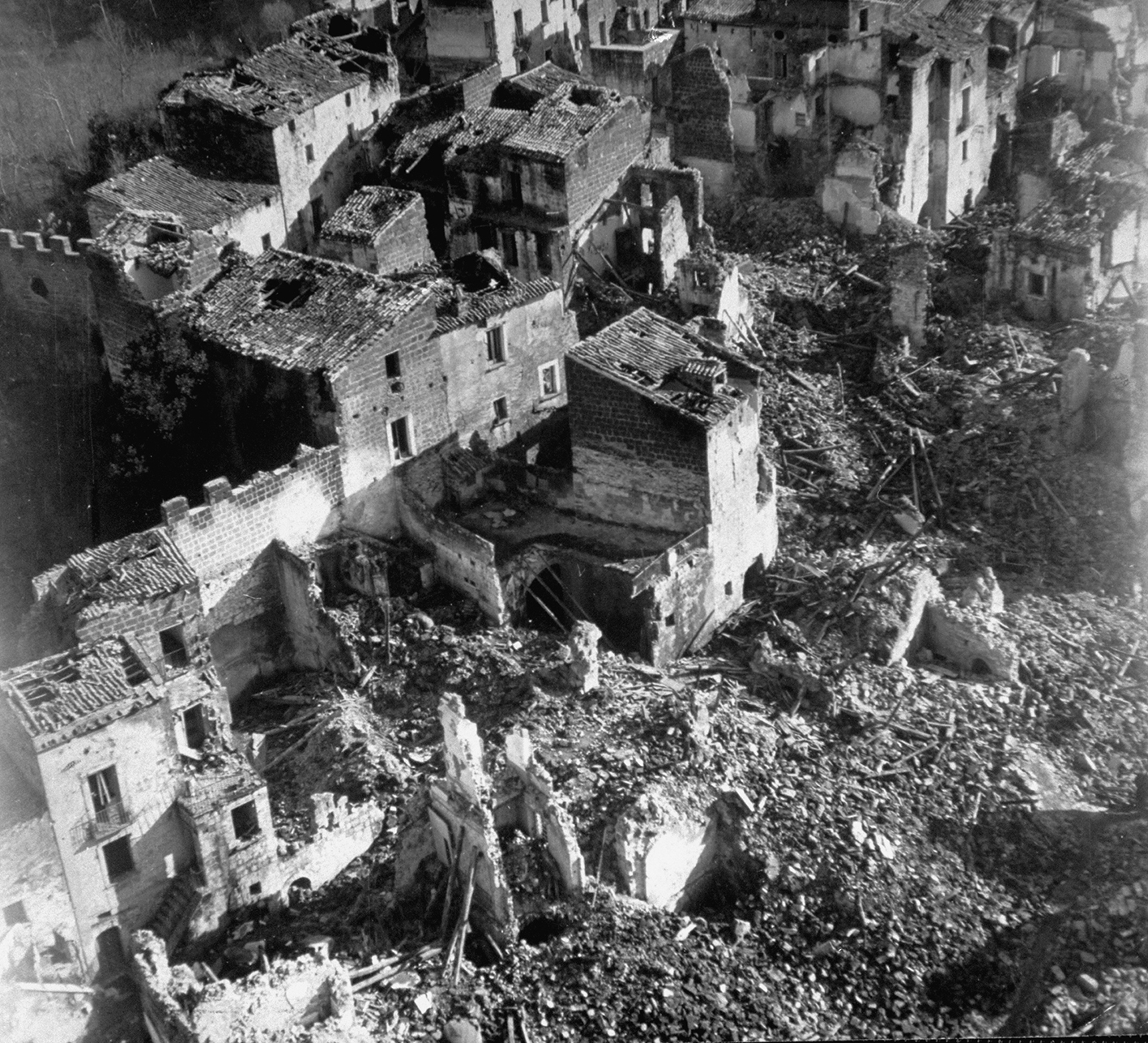
Aerial view of devastating ruins of this small town after it was shelled by Allies & then the Germans before it was captured on Dec. 12, 1943 by the Americans.. (Photo by Margaret Bourke-White/The LIFE Picture Collection/Getty Images)

Extract from page 22 : The Fifth Army at the Winter Line Center of Military History, United States Army, Washington, D.C., 1990. This work is in the public domain...


