dialogues for definition
Early research and first definition
The definition of Cultural Documents evolved from an empirical approach. In 2006, I (Deirdre MacKenna) sought ways of thinking/learning about how to represent the characteristics and issues faced by the people (local and diaspora) of the areas I was working in.
Aware that non-indigenous people (who have migrated from one country into another) are a minority in each of both their home and adopted/new places, I undertook an initial period of research for two reasons:
– to understand the extent to which information already existed (and therefore people might be pre-informed and have a sense of recognition/validation), and
- to build my archive of resources to draw from and inform the programme.
Given that the people I wanted to work with lived throughout Europe and also in Australia and the USA, I undertook a (rather long) period of thinking about evaluation and how to involve people so that their responses could inform my commissioning decisions; ultimately how people would make sense of and value Cultural Documents’ work.
I arranged many meetings with people (in their homes, places of work and other locations), initiating discussions by introducing myself, my work and the themes of the nascent programme. Concurrently, all year round, I attended many events to study the approaches of other artists, producers and programmers and started to travel to undertake a new series of meetings in the diaspora locations in Italy, France and the UK. I outlined the themes and motivations of my work and encouraged people to recognise my role initiating and shaping the process of reification of their stories and experiences and the places that situate aspects of their lives.
It was important that stakeholders expressed their understanding of my aims on their terms, so I encouraged them to share their thoughts and help me to explore two things:
– what was significant to them from their point of view, and
– how I could develop process/es which had potential for collaborations with them at all of its stages: research, production, promotion and presentation of the case study programme.
The initial phase of exploratory dialogues generated responses and raised related which Cultural Documents could address.
Even when less successful, my approaches to people always generated learnings and these gradually accumulated into dialogues, exchanges and events which enriched thinking about how physical spaces and a new conceptual arena could validate ideas and enable us to make sense of matters of common concern. These matters became increasingly clear and addressed the representation of the impact of human migration upon memory, identity, community, language, territory and terrain, in historical local, national and international contexts. As the vast subject emerged, so did the my termination to realise its representation, and looking back, I can clearly see that to a significant extent, my sense of conviction was empowered by the solidarity which was being generated by the dialogues.
At some stage, duration became defined as a crucial element, without which sustained dialogues and thinking would fail to evolve into trust and relationships. I also learned that the people I was working with had never encountered any representation of their lives; a sense of frustration and low self-esteem were omnipresent to the extent that they were occasionally used to define themselves. However, I suggested this as an opportunity to work free from the rhetoric of, for example, cultural institutions and in turn, this became a reliable source of optimism.
When I started my research, there were only two regular programmes of contemporary visual art in the region; Limiti Inchiusi, an independent collective (Fausto Colavecchia, Paolo Borelli, Luigi Grandillo and Dante Gentile Lorusso) in Campobasso and IoProjects (Agapito di Pilla and Lisa Esposito). Each worked to reify and validate the societies they were part of and we quickly grew strong roots of collaboration.
I also formed lasting dialogues which led to many research-phase collaborations with the Cosmo Iannone publishing house, the regional library Albino in Campobasso, independent museums and private collections Museo Winterline (Luciano Bucci and collaborators) and the Associazione per la Memoria del Territorio (Eugenio Verrecchia).
Beyond Molise, my research uncovered many sources in private and public collections/archives. For example, these included the only piece of work in the collections of the National Galleries of Scotland identified by Aidan Weston-Lewis, Oliver Morse’s private collection of works by photographer Frank Monaco and a myriad of sources throughout the world of photographic images documenting the conflict of WWII.
I also initiated dialogues with the Regione Molise proposing two things: that they start to strategically plan to create regular funding/support schemes to activate the talent in their constituents, and that they specifically fund my work to produce a programme which would activate the network called ‘Molisani new Mondo’ which they went on to produce themselves in 2014.
My enquires were initially met with attentive curiosity and gradually I received invitations to continue to develop my research which I consider evidence of the value of the phase of enquiry. When I recognised that my dialogues with some had progressed from responding with curiosity to unsolicited expressions of their own views, I felt it was time for me to commence production and presentation.
The first tangible collaborations comprised a new series of publications with Cosmo Iannone (pending) and an exhibition which I curated for Limiti Inchiusi in Campobasso in winter 2010/2011 as part of their ‘Fuoriluogo’ (beyond place) programme strand which I titled ‘A Purposeful Regression’ of works by Fausto Colavecchia, Don DeLillo, Douglas Gordon, Stephen Partridge, Giose Rimanelli and Elaine Shemilt.
Gradually, I started to outline the aims of the programme and invited a number of artists from a range of backgrounds and experiences to undertake an introductory visit to undertake research and consider how it may evolve into a potential commission.
Dialogues with each artist were unique to our common interests, in some cases continuations of previous dialogues and collaborations, and in others new. These evolved in response to their interest in the potential commission and their response to the area.
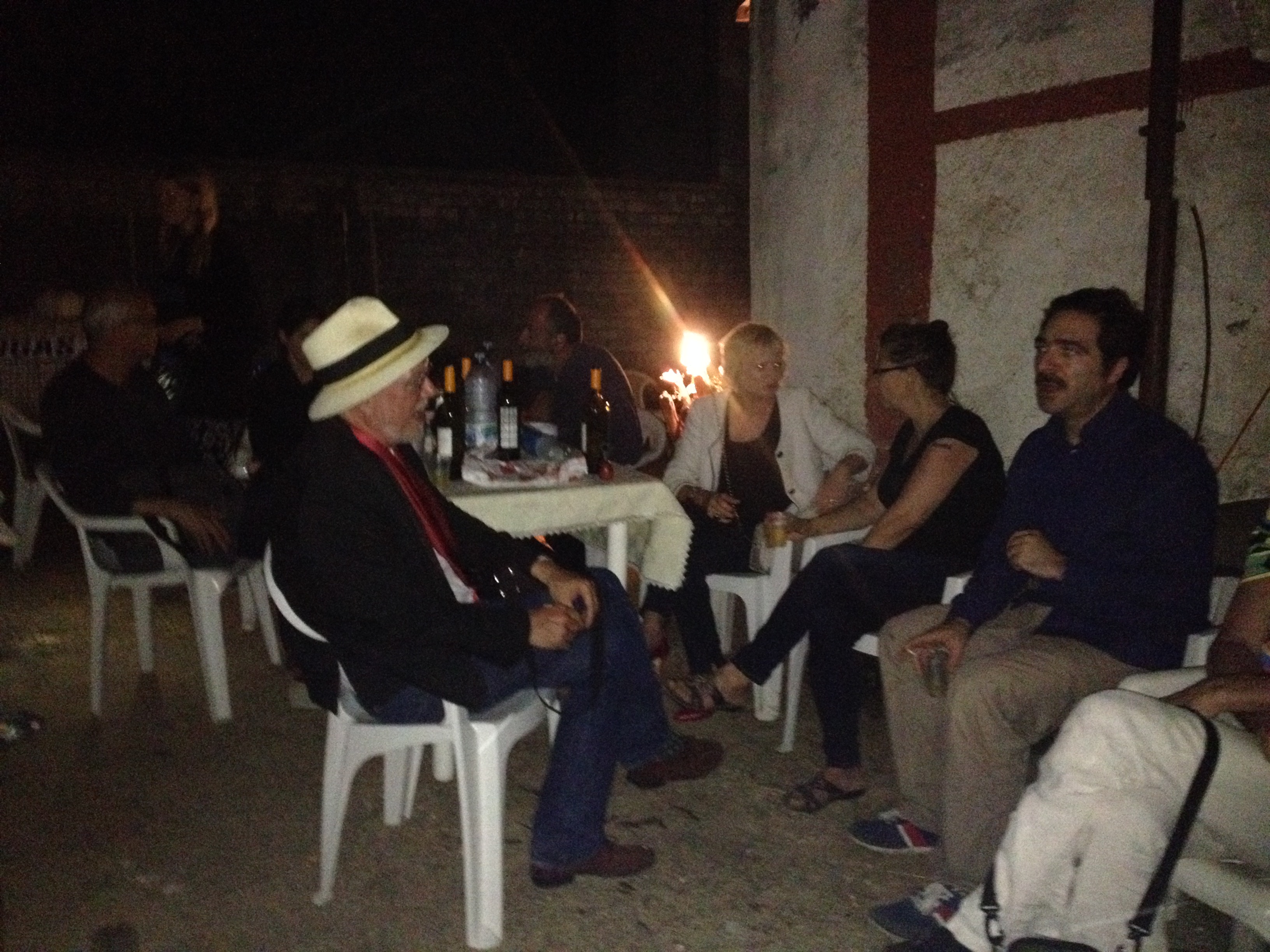
image: hosts and artists exchanging knowledge at a CD evening get-together: l to r: Stephen Partridge, Anne Carmichael Verrecchia, Nina Bacos and Agapito Di Pilla 2015 © Cultural Documents


