The Bread Boy of Herculaneum

Artists Anna Bokström and Nina Bacos have undertaken research in collaboration with people living in Greece, Italy, Scotland and Sweden.
Please see our EVENTS page for all events charting the research and engagement of this durational project.
Follow also this link to hear artists Anna Bokström and Nina Bacos in dialogue about their work and the aims they are fulfilling.
During 2019, 2020, 2021, 2022, 2023, 2024 ands 2025 the artists have undertaken a series of research residencies in Italy, Sweden and Scotland to
– identify partners,
– work closely with communities,
and gather knowledge about
– food production,
– processes of carbon management, and
– sources of fuel supply to residents.
This work is a long-term process which aims to represent the complexity of human attempts to generate sustainable circular economies which eschew global-scale fuel production and mitigate the threat of climate change.
The Bread Boy of Herculaneum stretches across five chapters comprising The Word for World is Forest, Post-home, Taxonomy, The Creation of Adam and Geology on Speed; these can be read individually and as part of an interrelated whole.
We invite you to engage with these images as a means to reflect on the processes of environmental change. The title ‘The Bread Boy of Herculaneum’ alludes to the death of a young boy and his entire community caused by the volcanic eruption of Mount Vesuvius in 79AC. The artists visited Herculaneum/Ercolano during their initial research phase and, distinct from the other archeological remains, the boy’s suffocation became emblematic of the concerns driving their work.
“Carbon dioxide levels in the atmosphere are the highest in 66 million years. This has put the climate systems into a state that has no analogue projections for the future”
(Anthropocene the Human Epoch, Baichwal, Pencier and Burtunsky 2018).
In geological terms, our current era is called The Anthropocene, named so because, for the first time in history, human activity has become the dominant influence on the planet earth.
The products we consumers use, such as cement/concrete, plastics, fuel and meat drive processes which, in turn, consume the planet’s resources. Industrial-scale extraction of resources (oil, sand, rock, minerals etc) destroy natural systems which ecologies and life-forms depend upon. We are all familiar by now with the consequences of imbalanced greenhouse gases (carbon dioxide and others) which set global warming in motion; disappearing carbon-capturing forests no longer create oxygen and melting glaciers and icecaps can no longer regulate global temperatures.
This is the gradual destruction of existence as we know it; our planet is in a state of environmental crisis.
In some places, for animals and humans alike, this dystopian future is already here; deforestation, increasing-temperatures, water shortage, flooding, desertification, wildfires and pollution have destroyed habitats; causing unprecedented extinction and mass migration. While the majority of the scientific community and a large proportion of the world’s leaders agree and commit to a carbon-free future, state governments have, so far, been unable to set collective operational plans to halt these life threatening changes.
image:
Port of Herculaneum. Anna Bokström and Nina Bacos. Napoli 2019 (detail)
The Word for World is Forest
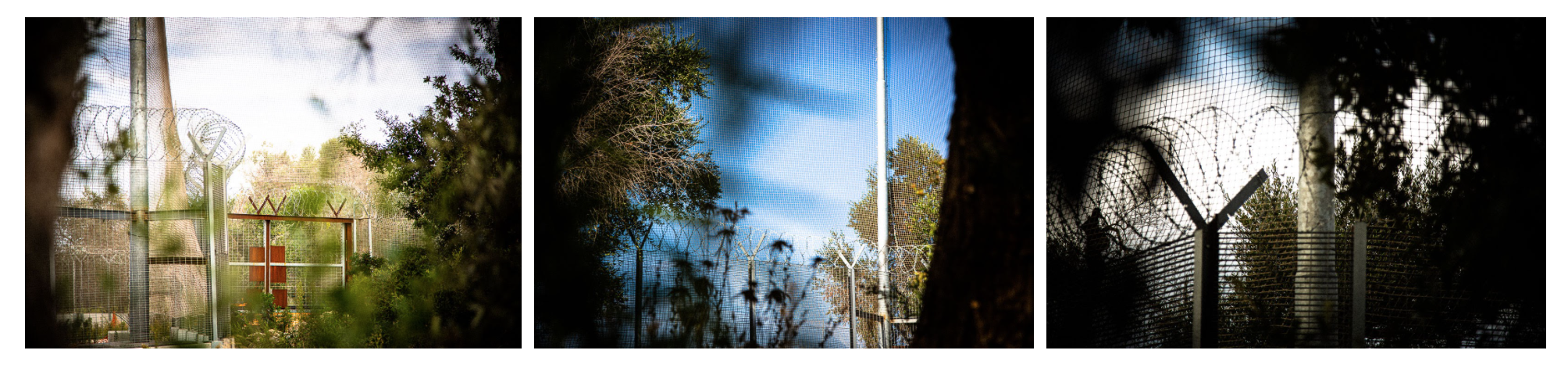
The chapter borrows the title of Ursula Le Guin’s eponymous book which narrates a tale of colonialist expansion into an unexploited, resource-rich planet named Athshe.
The artists are positioned outside the barbed-wire, electrified barricade that surrounds the construction of a pipeline. Having been denied permission to document the pipeline-construction, the artists find a viewpoint between the trees and shrubs which provides a narrow field of vision to undertake their surveillance of the pipeline’s progress.
The images document construction of the Trans Adriatic Pipeline (TAP) outside the Italian town of San Foca, where the pipeline emerges from the bottom of the sea. The TAP is part of a chain of infrastructural pipelines named the Southern Gas Corridor, which transports fossil-fuel gas over three thousand kilometres to deliver fossil fuels from the Caspian Sea in Azerbaijan into the households of EU member countries. The Southern Gas Corridor is owned by groups of companies registered across the world, most in countries which have pledged to progressively end fossil fuel dependency in order to reverse or halt climate change.
Crossing a diverse range of cultural, climatic and topographical areas, the pipelines, literally, cut through the terrain and seas they traverse. In some areas, this causes complete alteration of the terrain and habitats, such as in these images which, for many centuries before the pipeline, had been farmed as an olive grove.
image: composite of images from the chapter
The Word for World is Forest by Nina Bacos Anna Bokström.
Melendugno Italy, September 2019
Post-home

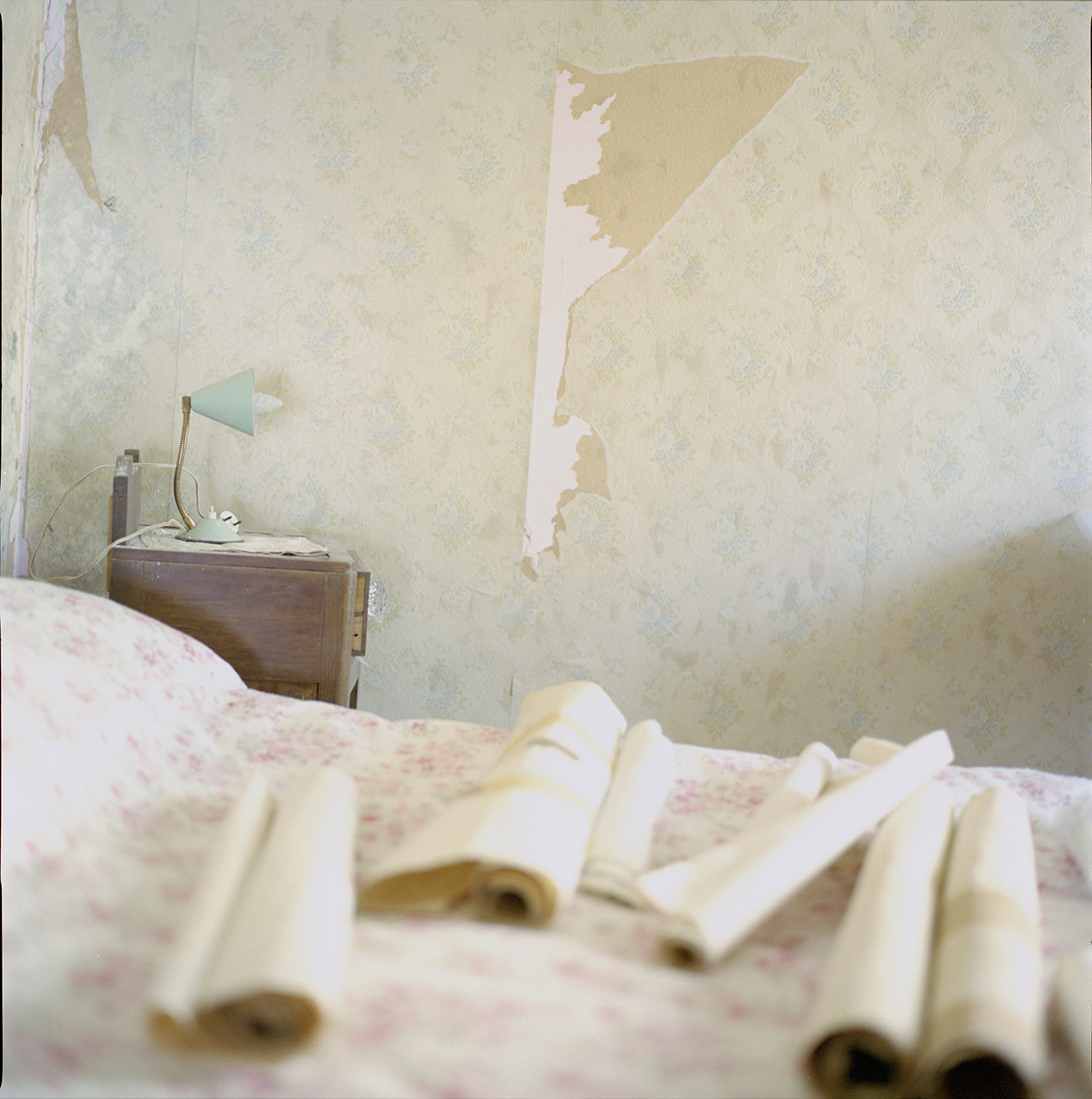
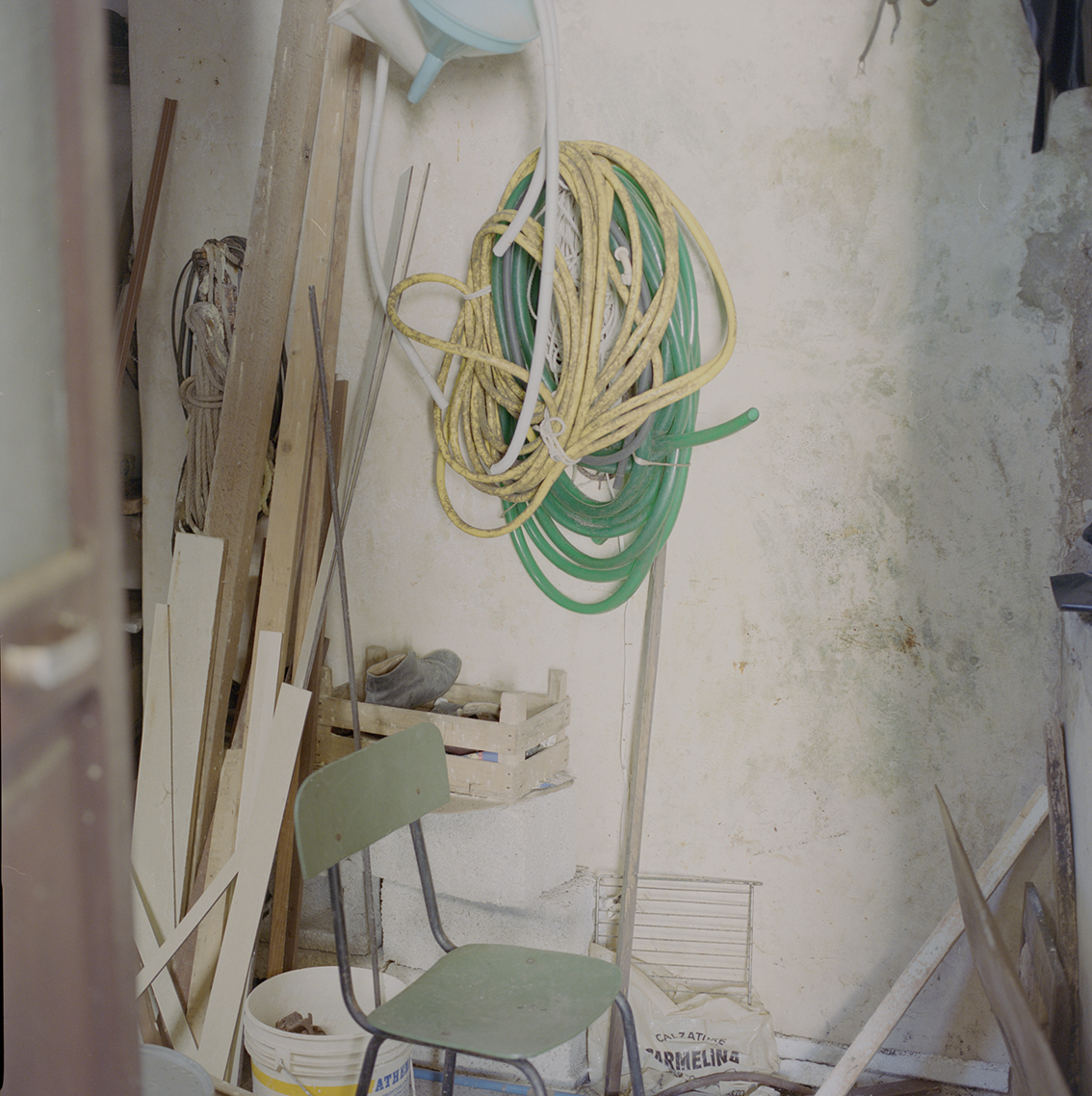
This chapter of images documents an empty building, an ex-home, in a rural village in central Italy, in this case the home of Pietro Ferri, who died in 2007 aged eighty-six.
Pietro was self-employed all his life: he provided for his family of seven children from his own land/smallholding and by providing the services of barber and cobbler.
The village of Filignano conforms with the mass migration from the rural to the urban which characterises the 19th and 20th centuries; where three thousand people lived, today live 600. Such is the rate of depopulation that the built environment is characterised by empty houses. Pietro’s house lies unused because it is no longer needed.
The images familiarise the viewer with a home given way to a kind of entropy, a natural process of decline which occurs if objects and spaces/places are no longer gestated by humans.
images:
• Post Home. Anna Bokström and Nina Bacos. Filignano June 2019
• State of Decomposition. Anna Bokström and Nina Bacos. Filignano June 2019
• Ownership. Anna Bokström and Nina Bacos. Filignano June 2019
Taxonomy
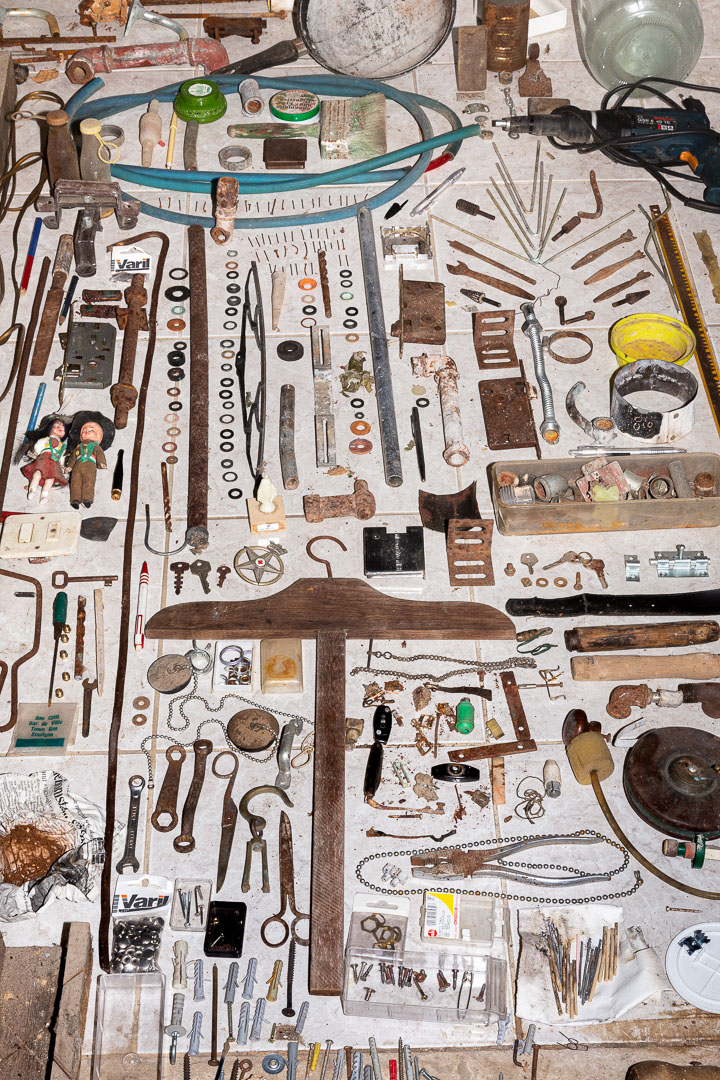
Taxonomy III. Anna Bokström and Nina Bacos. Filignano, June 2019
This chapter of large images lays out the objects in Pietro’s house, in a manner which echoes the categorisation of objects in scientific research.
These are the artists’ attempts to think through rationales for representing the vast array of objects in order to enable us, the viewers, to obtain a sense of the objects which Pietro surrounded himself with in his everyday life. By using photography to explore and raise consideration of the materials, design, craft, function and sheer diversity, they aimed to reactivate the objects in new contexts, and restore and attribute significance to them.
The objects include well-known branded products as well as fully functioning tools which may have been in use for centuries.
What do you see?
image:
Taxonomy 1. Anna Bokström and Nina Bacos. Filignano, June 2019
The Creation of Adam
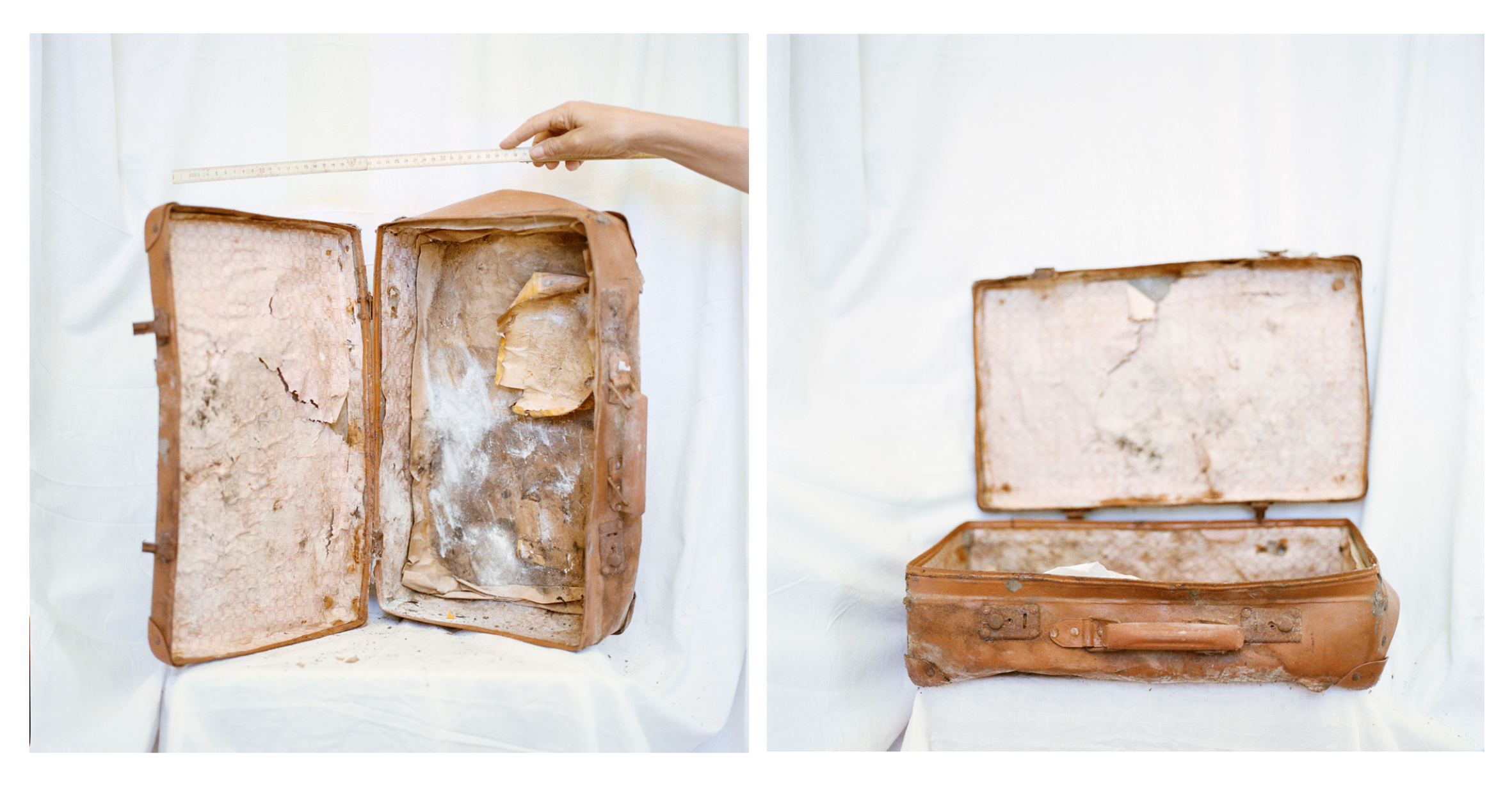
The images in this chapter are composed using a fabric backdrop, with Pietro’s objects having been photographed twice; alone and with a hand interjecting to hold or measure the object. The artists are experimenting with a taxonomy, an imposed process which, through a pre-established hierarchy of classifications, imbues objects with value or significance.
In contrast to the other chapters, where the artists have followed their own sense of visual organisation, they have made these images following the tradition of classical portraiture which prioritises accentuation of the ‘beauty’ of the subject and employs soft focus, heightened colour palette and formal composition.
However, the artists break the rules by acting out an intervention; by including their hand or arm in the compositions they measure, indicate or hold the objects, betraying the process and its producer. The indication of measurement draws our attention to the ultimate quantification of the objects, and the need for them to fit into a predetermined register or set of values.
images – left to right
Open trunk. Anna Bokström and Nina Bacos. Filignano June 2019
Lone open trunk. Anna Bokström and Nina Bacos. Filignano June 2019
Geology on Speed
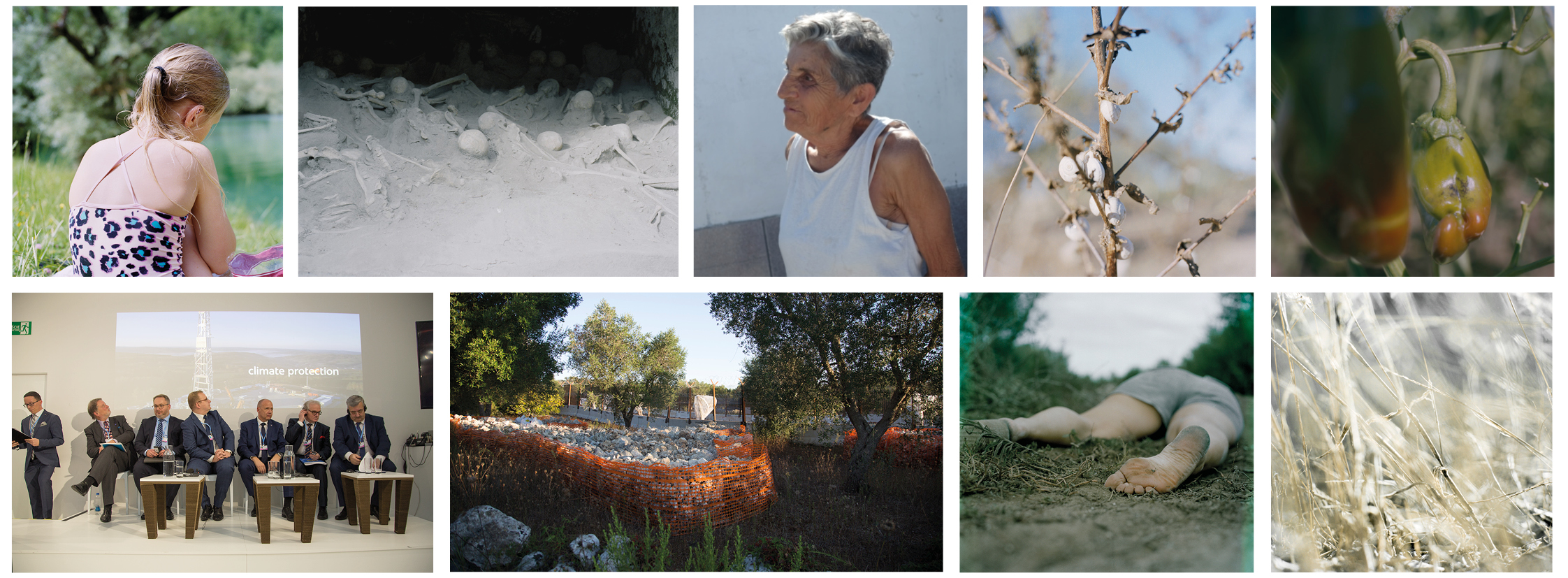
Meandering between images intended to represent beauty, fear, industry and habitats, the artists have made this apparently disparate selection to juxtapose the diversity of stakeholders involved in the inherent political and personal nature of demand and supply of fossil fuels.
images top row:
• Marie by Lake / Habitat 3. Anna Bokström and Nina Bacos. Cardito Molise 2019
• Port of Herculaneum. Anna Bokström and Nina Bacos. Napoli 2019
• Abbondanza NoTap Activist. Anna Bokström and Nina Bacos. Melendugno 2019
• Habitat 2. Anna Bokström and Nina Bacos. Melendugno 2019
• Edward Weston would have croaked. Anna Bokström and Nina Bacos. Melendugno 2019
images lower row:
• Conference of the Parties (COP24) Lounge, Anna Bokström, Katowice 2018
• TAP site. Anna Bokström and Nina Bacos. Melendugno 2019
• Knock On. Anna Bokström and Nina Bacos. Melendugno 2019
• Habitat 1. Anna Bokström and Nina Bacos. Melendugno 2019
“The needs of the moment win over the promises of a future.”
Karl Ove Knausgård
Read more about the Artists at these links: Anna Bokström and Nina Bacos
Read more about the events at these links:
Exhibition of The Breadboy of Herculaneum – Sweden, Laholm – Stadshusgalleriet. September to November 2025
Exhibition of The Breadboy of Herculaneum – Scotland, Dunoon – Dunoon Burgh Hall. 19 January to 10 March 2024
Event – grow food discussion – Scotland, Dunoon – Dunoon Burgh Hall. 21 January 2024
Online Interview Recording – Martin Gerish in dialogue with artists Anna Bokström and Nina Bacos about their work and the aims they are fulfilling.
Event – Samhain at Bullwood Nature Trail, Dunoon – The Breadboy of Herculaneum. 31 October 2023
Exhibition of The Breadboy of Herculaneum – Italy, Molise – Caffe del Borgo, Filignano. 28 July to 10 November 2023
Exhibition of The Breadboy of Herculaneum – Sweden, Torsås – Kulturmagasinet in Bergkvara. 10 September to 19 November 2022
Exhibition Clima, Cibo, Cultura – Italy, Molise – Casa Pleiadi in Sant’Agapito. 29 July to 8 September 2022
The Bread Boy of Herculaneum is made in partnership during a series of research residencies and event-collaborations with the communities of our partners in…
Italy, Molise – Casa Pleiadi in Sant’Agapito
Italy, Molise – Caffe del Borgo, Filignano
Sweden, Torsås – Kulturmagasinet in Bergkvara
Scotland, Argyll – Dunoon Burgh Hall
Commissioned by Cultural Documents in 2019
with work during 2023 funded by Creative Scotland.